

Faith Untouched: The story of the 22 Catholic Martyrs
Explore the factual history of the twenty-two Catholic Uganda Martyrs. From the royal court of Munyonyo to the fires of Namugongo, discover a legacy of conviction that transformed a nation and birthed the modern African Church.
- Title: The Account Of The Twenty-Two Catholic Uganda Martyrs: A History Of Faith And Sacrifice
- Description: From the royal palace of Munyonyo to the sacred fires of Namugongo, discover the factual account of the young men who chose faith over fear. A journey through the 1886 sacrifice that changed Africa forever.
- Featured Image: An Animated Procession of the Uganda Martyr Relics on 3rd June 2025

The martyrdom of twenty-two Catholic converts in the Kingdom of Buganda between 1885 and 1887 represents a defining chapter in the history of the global Church. These men (pages, officials, and artisans) confronted a choice between their lives and their religious convictions. Their story is a factual record of courage that continues to inspire millions.
If you are reading this, you are likely someone with a restless heart; a holidaymaker not just seeking for new landscapes, but for meaning. You’ve perhaps walked the ancient pilgrim paths of Europe or stood in awe before the great cathedrals. You are searching for a place where history isn’t just studied, but felt in your bones.
KPJ
The Political and Religious Crucible
In the late 19th century, the Kingdom of Buganda functioned as a sophisticated sovereign state. The arrival of Anglican missionaries in 1877 and Catholic White Fathers in 1879 introduced new spiritual and social structures.
Upon ascending the throne in 1884, Kabaka Mwanga II inherited a kingdom under pressure from colonial expansion and internal religious shifts. The king viewed the rapid spread of Christianity among his most trusted court officials as a threat to traditional Buganda authority. This friction created a hostile environment where religious adherence became a political act.
Historical Setting at the Kabaka’s Court
Between 1885 and 1887, the royal court of Buganda under Kabaka Mwanga II became a place of intense religious and political strife. Mwanga, who ascended the throne in 1884 at age 18, ruled a kingdom marked by shifting alliances amid European missionary arrivals. Catholic missionaries from the White Fathers had arrived in 1879, followed by Anglicans, introducing Christianity to young pages, officials, and artisans in the court. These Ugandans (mostly in their teens and twenties) embraced the faith amid a culture blending traditional religion, Islam, and emerging colonial pressures.

The First Witness: St. Joseph Mukasa Balikuddembe
The period of execution began with St. Joseph Mukasa Balikuddembe, the chief steward of the King’s court. A senior advisor and a man of great integrity, Balikuddembe publicly disapproved of the king’s decision to execute Anglican Bishop James Hannington. On November 15, 1885, Balikuddembe became the first Catholic martyr. He was beheaded at Nakivubo, offering a message of forgiveness to the king before his death.
The Courage of St. Charles Lwanga and the Pages
Following the death of Balikuddembe, St. Charles Lwanga assumed leadership of the Christian pages. Lwanga served as a protector, guiding the young men through the increasing dangers of the court.
The crisis peaked in May 1886. When the king demanded that his pages renounce their faith, Lwanga acted swiftly. On the night of May 25, he baptized those still in the catechumenate, including St. Kizito, the youngest martyr at age fourteen. The following morning, when the king ordered the Christians to separate themselves from the rest of the court, Lwanga and his companions stepped forward.
The Journey to Namugongo
The condemned were forced to walk approximately 27 kilometres from the Munyonyo palace to the Namugongo execution site. This trek was a brutal ordeal designed to break their resolve. Several martyrs were killed along this route:
- St. Pontiano Ngondwe and St. Denis Ssebugwawo were martyred at Munyonyo.
- St. Andrew Kaggwa and St. Athanansio Bazzekuketta died shortly after beginning the march.
- St. Gonzaga Gonza collapsed and was killed at Lubowa.
- St. Matthias Mulumba endured a slow death at Old Kampala after being left for three days.
Upon reaching Namugongo, the survivors were imprisoned for one week. During this time, they prayed and sang hymns, refusing to abandon their beliefs.
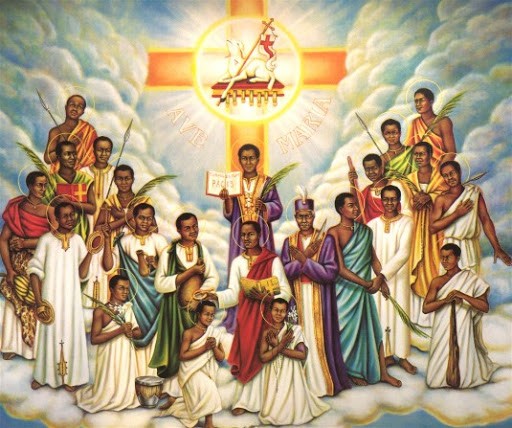
The sacrifice by fire of June 3, 1886
On the Feast of the Ascension, June 3, 1886, the final executions took place. St. Charles Lwanga was separated from the group and executed over a slow fire at the spot where the main altar of the Munyonyo Minor Basilica stands today. He remained in prayer until his final breath.
The remaining martyrs were wrapped in reed mats and placed upon a great funeral pyre. Witnesses noted that as the flames rose, the sounds of prayer and praise emerged from the fire. These men died not as victims, but as witnesses to a truth they held dearer than life.

Canonization and Global Recognition
The sacrifice of these men resonated far beyond the borders of Uganda. Their blood became the seed of the Church in Africa.
- Beatification: Pope Benedict XV beatified the martyrs in 1920.
- Canonization: Pope Paul VI canonized the twenty-two Catholic martyrs on October 18, 1964, during the Second Vatican Council.
This was the first time in the modern era that African saints were raised to the honors of the altar. In 1969, Pope Paul VI visited Namugongo, becoming the first reigning Pope to visit sub-Saharan Africa.

The Legacy of the Twenty-Two
The twenty-two martyrs represented a cross-section of society, from the high-ranking St. Andrew Kaggwa to the young page St. Kizito. Their unity across social classes proved that faith is a universal equalizer.
Today, the Uganda Martyrs Basilica at Namugongo stands as a site of global pilgrimage. Every June 3rd, millions of believers gather to honor their memory. The presence of relics, such as those presented during the 2025 commemorations, serves as a physical link to their historical existence.
The martyrs did not seek death but they sought a life of integrity. Their legacy lives on in the hospitals, schools, and parishes that bear their names, and in the enduring strength of the Ugandan Catholic community.

The Witnesses: A Biographical Directory of the Catholic Martyrs
The following men were canonized by Pope Paul VI on October 18, 1964. Their lives serve as distinct pillars of the Ugandan Church, each offering a unique patronage based on their earthly roles and the nature of their sacrifice.
The Leaders and Guardians
- 1. St. Joseph Mukasa Balikuddembe (Martyred Nov 15, 1885): The Majordomo and senior advisor to the King. He was the first to die for speaking truth to power.
- Patronage: Politicians and Civil Servants.
- 2. St. Charles Lwanga (Martyred June 3, 1886): The lead page and protector of the youth. He guided the community through the darkest hours of the persecution.
- Patronage: African Youth and Catholic Action.
- 3. St. Matthias Mulumba (Martyred May 30, 1886): The oldest martyr and a highly respected Assistant County Chief. He endured a lingering three-day death with profound silence.
- Patronage: Families, Married Couples, and Chiefs.
The Young and the Brave
- 4. St. Kizito (Martyred June 3, 1886): The youngest of the group at age fourteen. His joy in the face of death remains a powerful symbol of innocence.
- Patronage: Children and Primary Schools.
- 5. St. Denis Ssebugwawo (Martyred May 25, 1886): A modest page known for his musical talent. He was the first to be personally attacked by the King during the 1886 trials.
- Patronage: Musicians and Choirs.
- 6. St. Gyavira Musoke (Martyred June 3, 1886): A page in the King’s private chambers.
- Patronage: Victims of Slander and False Accusations.
The Professionals and Artisans
- 7. St. Andrew Kaggwa (Martyred May 26, 1886): The Head of the King’s Band. He turned his home into a center for teaching the faith.
- Patronage: Teachers, Catechists, and Families.
- 8. St. Luke Baanabakintu (Martyred June 3, 1886): A skilled fisherman and blacksmith.
- Patronage: Fishermen and Mechanics.
- 9. St. James Buuzabalyawo (Martyred June 3, 1886): A member of the King’s royal guard.
- Patronage: Soldiers and Security Personnel.
- 10. St. Anatoli Kiriggwajjo (Martyred June 3, 1886): A page who refused a high-ranking promotion to remain faithful to his beliefs.
- Patronage: Farmers and Hunters.
The Converts and Newcomers
- 11. St. Pontiano Ngondwe (Martyred May 26, 1886): A soldier who was already in prison for his faith when the general persecution began.
- Patronage: Soldiers, Policemen, and Prisoners.
- 12. St. Athanansio Bazzekuketta (Martyred May 27, 1886): A young page in charge of the King’s ceremonial robes.
- Patronage: Treasury and Banking Officials.
- 13. St. Gonzaga Gonza (Martyred May 27, 1886): A page whose chains broke during the march to Namugongo; he was martyred where he fell.
- Patronage: Prisoners and the Afflicted.
The Faithful Companions at Namugongo (The following were all martyred in the great fire on June 3, 1886)
- 14. St. Ambrose Kibuuka: Known for his unwavering cheerfulness.
- Patronage: Societies and Youth Clubs.
- 15. St. Achilles Kiwanuka: A page who renounced traditional practices for the Gospel.
- Patronage: Clerks and Pressmen.
- 16. St. Adolphus Ludigo Mukasa: Known for his kindness and pastoral care for others.
- Patronage: Farmers and Herdsmen.
- 17. St. Mugagga Lubowa: A young page who displayed maturity beyond his years.
- Patronage: Tailors and Community Builders.
- 18. St. Mukasa Kiriwawanvu: A wrestler and page in the King’s audience hall.
- Patronage: Athletes and Sportsmen.
- 19. St. Noa Mawaggali: A humble potter who was speared and hung from a tree at Mityana.
- Patronage: The Poor and the Working Class.
- 20. St. Bruno Sserunkuuma: A former soldier who returned to his faith with intense devotion.
- Patronage: Repentant Sinners and Temperance.
- 21. St. Jean-Marie Muzeeyi (Martyred Jan 27, 1887): The final martyr of the group, known for his wisdom and medical knowledge.
- Patronage: Doctors, Nurses, and Pharmacists.
- 22. St. Mbaga Tuzinde: The son of an executioner who refused his father’s plea to renounce his faith.
- Patronage: Religious Vocations and Seminarians.

Sacred: These patronages are widely recognized within the Archdiocese of Kampala and are used to help believers seek specific intercession. Each name represents a life that was lived with purpose before it was offered in sacrifice.

If this article touched something in you, share it with someone who needs to hear about unwavering devotion. And if you’re looking for more information on how to make your visit to Uganda and specifically on the Uganda Martyrs day, every 3rd JUNE please visit website of the Kampala Archdiocese.
THE UGANDA MARTYRS: A LEGACY OF FAITH AND FIRE
Faith Untouched: The story of the 22 Catholic Martyrs
— Social Communications Kampala Archdiocese