


ST. ACHILLES KIWANUKA
He was born at Lulagala in Mityana Ssingo around 1869. His father was called Kyazze and his mother was called Talidda Nassaza, daughter of Mukwenda Ddumba. His father was an efficient deputy County Chief for a long time. His son soon became famous like his father and at 15 he was selected to serve the King as a page. He was brown handsome, jolly, and polite. He was courageous, kind, trustworthy, obedient, composed and responsible. He soon converted to Catholicism and destroyed the amulets he had all along carried to protect him. But the parents and relatives got very angry with him for doing that. The boy was determined to follow Jesus Christ. He had very deep faith and heroically lived and defended the virtue of chastity. Kiwanuka was interested in learning how to read and write. Sometimes he served as a messenger. He was a good singer. He died a martyr at Namugongo on June 3, 1886 at the age of seventeen. He is the Patron of journalists, press, writers, printers and artists.

ST. ADOLPHUS MUKASA LUDIGO
Ambrosi Kibuuka was born at Butuzzaliiso Ssingo around 1868. His father is Kisuule Balamaze and his mother is Wampera, the only boy who survived for the other boys died soon after birth. His father, an official of the King’s Band known as “Mujaguzo” very much loved his son whom he named Katikamu and Mulundaggana. Kibuuka was taken to the palace as a page at fifteen years of age and entrusted to Joseph Mukasa who in turn entrusted him to Charles Lwanga. He was social, very kind, talented in games, always cheerful and charitable. He would work for long hours without showing any sign of fatigue. He became an ardent catechumen and was baptized by Pere Mapeera on 16/11/1885. When the Christians were arrested, his friend Kigongo went to inform his parents of the arrest. He was burnt to death at Namugongo on June 3, 1886. He is the Patron of societies and youth movements such as scouts, YCS, Xaverians, and so on.

ST. AMBROSE KIBUUKA KATIKAMU
He was born at Misazi, Myeri, Kyenjonjo, Butiti Parish. He is the son of Bamwesekesa and Kyote the mother with whom Mukasa Ludigo Tebyalirwa was kidnapped and brought to Buganda where he grew up. In Buganda he was given the name Mukasa and later nicknamed Ludigo because of his resemblance of the Mutaka Ludigo from Busoga. He was in charge of the King’s gardens where the pages were supposed to work. He started frequenting Catholicism in 1881 but was not baptized until 16th November 1885 by Pere Mapeera. Adolf Ludigo was exceptionally calm, intelligent and thoughtful. He despised no work and he often cooked for his fellow Christians to whom he was very kind and generous. He was very proud of being a catholic so much so that when summoned at the palace to defend themselves, he put on his best attire and after condemnation walked to his death in majestic fashion until his beautiful dress was removed from him at Ssezibogo tree as custom demanded. He was burnt to death at Namugongo on June 3, 1886 at the age of twenty-four. He is the Patron of farmers, herdsmen, etc.

ST. ANATOLI KIRIGGWAJJO
He was born at Kinyiira, Bubango, Buyaga in Bujuni Parish in 1860. His father is Siita but his mother’s name is unknown. He was named Karubagira. He grew up in chief Rugelwa’s enclosure at Nyakabango. During the Buganda raid of 1876, Karubagira was captured and brought to Buganda. Kisomose who took him as his slave, gave him the name Kiriggwajjo, saw his giftedness and wonderful virtues and took him to King Muteesa to serve in the palace. He was placed under Mukasa Balikuddembe. It is during his service in the place that he began learning catechism. He was baptized on 16 November 1885. Kiriggwajjo was a skilled hunter and a good herdsman. He used his talents whenever he had a chance to. He also served under King Mwang the inner palace as a page, and the King, who loved him, promoted him to a post of catering princesses. Anatoli found out that the post would endanger his noble virtue of chastity. He, thus, dared to decline the post though he was sure that it would result into the loss of his life. Although at this material time the King got annoyed, he did not order his death. But when the Christian persecution began, the King singled him out and said: “This Munyoro page refused the post I gave him, thus despising me”. Anatoli loved his faith, lived it happily, sought to understand it better and then teach it to others. Together with Charles Lwanga, they strengthen their brothers to be strong in witnessing to their faith until death. He was burnt to death on June 3, 1886. He is Patron of hunters and herdsmen.

ST. ANDREW KAGGWA (KAHWA)
He was the third person to be martyred. Kaggwa was born at Kkooki Bugangazzi Bukuumi Parish around 1856. His father was Kahawa Kabijenge and his mother’s name remains unknown. Kahawa was captured as a child during the Buganda raids brought to King Muteesa I’s palace where he grew up. He was very much loved by the king. He was creative, kind, very jolly and a wonderful conversationalist. The King had him trained by Toli, a madagacan who had come with his band and used to play for the king, and Kaggwa became a professional police officer, a skillful shooter and a great band master. He learnt how to read, speak and write Arabic and Swahili. He was made head of the Police. He learnt also carpentry and cleaning guns from Toli. He is understood to be the first formal teacher in Uganda with a training home at Nateete. He first followed Islam but later joined the protestant faith and finally settled with the catholic faith at the arrival of the catholic missionaries. He was a very committed catechumen and was baptized on 30th April 1882 by Pere Mapeera. He was very kind and committed to teaching others the faith in words and actions. He was a pious and zealous catholic. He served both King Muteesa and King Mwanga. He was hingly trusted by both kings, however due to the jealousy of Kintu the Prime Minister; he was beheaded after his hands had been chopped off on 26th May 1886 in the Banana plantation of Kintu. Andrew is the Patron of teachers, catechists and families.

ST. ATHANASIUS BAZZEKUKETTA KIZZA
He was the fifth to be martyred. He was born at Mukuma Bulemeezi in Mulajje Parish around 1866. His father was Kafeero Ssebaggala Kabaalu of the Nkima clan and his mother was Namukwaya of the Mbogo clan. He was very trustworthy. He was a clean, orderly, faithful and obedient person. He was in charge of the King’s ceremonial robes and ornaments. He was also in-charge of the King’s treasury and ivory. He joined Catholicism and became an ardent catechumen. He was baptized on 17th November 1885. When he was arrested, he was eager and happy to die for Jesus Christ. The next morning on their way to Namugongo, Mukaajanga asked, “Who would like to be killed here where your Christian leader Balikuddembe was killed?” At once Athanasius answered: “Here I am. Why delay me and take me all the way to Namugongo as if death cannot be met here?” He was then speared to death at Nakivubo on May 27th 1886, aged twenty. He is the Patron of those in charge of finance, treasury and banks.

ST. BRUNO SSERUNKUUMA
He was born at Masaka around 1856. His father was Kizza Kibuuka Majalya Namujulirwa. His brother Mbugano is the one who took him to the palace as a page. Here he met Mukasa Balikuddembe who taught him the catholic faith. He was baptized on 16 November 1885 by Pere Giraurt. Before he embraced the Catholic faith, Sserunkuuma was violent, hot-tempered, cruel, imprudent, drunkard and led a loose life. He, however, strove bravely to master his temper and control his passions. The King gave him two girls for wives in appreciation for his good services. He took them home. But his fellow Catholics pointed out to him that the new religion they had embraced did not allow more than one wife. He repented and did spend much time in prayer, penance and did works of charity. On his way to Namugongo, his brother Bbosa gave him beer. But remembering the thirst of Jesus Christ on the cross, he refused it. He constantly and bravely encouraged others not to give up. He died a martyr on June 3, 1886. Sserunkuuma is the Patron of those tempted to excessive drinking, lust and those not properly married in the Church.
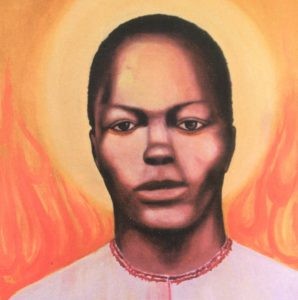
ST. CHARLES LWANGA
He was the ninth to be martyred. Charles Lwanga was born between 1860-1861 at Kasanje Birinzi. He is a real Munnabuddu, the son of Mr. Mabingo of Ngabi Clan and Mrs Gwokiiya of Kasimba. He was the last born of his siblings and grew up in the Enclosure of chief Mawulugungu of Kyaato that had married his paternal aunt Mukangula Batamiivu. Here he learnt art of governance and administration. Between 1878-1879, Lwanga and his friends used to be sent to the capital by chief Mawulugungu and in so doing they came into contact with the catholic missionaries. This contact became more frequent when chief Mawulungungu was transferred to Singo. Lwanga was handsome, brown, tall, strong and stately, kind, industrious and committed to duty. He was taken into service of King Mwanga by Mukasa Balikuddembe in 1882. He was an excellent and gifted leader full of creativity and initiative. He was humane, honest, trustworthy, cultured and full of civility. He helped to dig the Kabaka’s lake and governed the pages with incredible wisdom. He was baptized on 15th November 1885. He was an exceptional leader of the Christians. Lwanga is admired for his strong faith, his piety and practice of the virtue of religion, his concern for the salvation of others and untainted virtue of chastity. He was a man of unshakable faith and bravery sustaining and strengthening his brothers during the persecution period. He was brutally and bizarrely murdered by his avenger, Ssenkoole, separating him from the group and burning him in a slow fire from foot to head at Namugongo Busaale to give him maximum pain on 3rd of June 1886 towards noon. He was only twenty-five years old. He died praying for the conversion of the executioners and the King. St. Charles Lwanga is the Patron of the African youths and Catholic Apostolic Action, a mission in which all Christians participate.

ST. DENNIS SSEBUGGWAWO WASSWA
He is the second martyr to be killed. He was born at Kigolooba, Wakyaato, in Bulemeezi, Kijjaguzo Parish around 1869. His father was Kajjansi Ssebuggwawo of the Musu clan and his mother was Maria Nsonga Nabalongo from Busoga. He was calm, relaxed, rather quiet but jolly, gentle and acting maturely, free from vulgar language. He had a very good voice and good at singing. He was taken to the palace to serve as Mwanga’s page when he was about 14 years old. He was baptized on 17th November 1885. He was a very pious and zealous Christian, always willing to teach others the catholic faith, example of which is Muwafu whom he was teaching and that became the source of his brutal death on 25th May 1886. Severely scourged by King Mwanga, he was killed the following morning at Munyonyo. He was very humble and zealous for the faith. He is the Patron of singers, musicians and others.

ST. GONZAGA GONZA GONZABATO
He was the sixth to be martyred. He was born around 1862 in Busoga, the son of Gonzabato. He was kidnapped when still a child and brought to Buganda and grew up in the family of Nkambo Buluusi who treated him as his own son. Gonzaga behaved well and was obedient, exceptionally kind, trustworthy, intelligent and hardworking. He was taken to King Muteesa’s palace aged about 12 years. He first professed Islam, the Protestantism and later became a catholic being baptized on17th November 1885. Gonzaga was a zealous and pious Catholic. He decided to go to prison on behalf of Namulabira who had been falsely accused of befriending a princesses and Nakya, one of the kings wives. Gonzaga was arrested at Munyonyo and spent the night in chains. The executioners failed to remove them. But Gonzaga was determined to drag the chains fastening his bleeding legs to Namugongo. On the way he collapsed and was speared to death by Mukajanga and died on May 27th, 1886 at the age of twenty-four. Gonzaga is the Patron of prisoners, travellers, the ill-treated and those in trouble.

ST. GYAVIIRA MAYANJA MUSOKE
Gyaviira was born at Sseguku in Busiro between 1869-1870. He was the son of Ssemalago, the traditional priest of Mayanja and belongs to the Mmamba clan. His mother is unknown. His father gave him the name of Musoke and later on Mayanja, while his friends at the palace nicknamed him Gyaviira. He was taken to the palace as a page immediately after Mwanga had become king around 1884. His father was a famous priest of the traditional god, Mayanja. He gave this name Mayanja to his son, in a gesture of preparing him to take over his office. But when Gyaviira was taken to the palace to be a page, he converted to Catholicism and burnt up all witchcraft charms. He was baptized by Charles Lwanga on 26th May 1886 and was burnt at stake together with others at Namugongo on June 3rd , 1886, at the age of seventeen. St. Gyaviira is the Patron of traffic, communications and those troubled by witchcraft.

ST. JAMES BUUZABALYAWO KALUMBA SSEBAYIGGA
He was born in Ggoli Kiswa, Mawokota, Ggoli Parish around 1861. His father was Ssebikejje Kibazzi of Ngeye clan ad his mother was Lwambuzabugyo of the Nsenene clan. He was named Kalumba in his childhood. He was taken to King Muteesa I palace by princess Namukabya. Here is first frequented the moslem, when the protestant missionaries came he went to them and finally when the catholics came he joined them and became a serious catechumen under the instruction of Andrea Kaggwa. He became a Catholic mainly after admiring the celibacy of the Catholic Missionaries and the behaviour of Catholics. He was one of the able leaders of the King’s band. On Tuesday, May 25, 1886, when the King Mwanga broke into rage and tortured Denis Ssebuggwawo, he proceeded to Buuzabalyawo’s place. He ordered his arrest for being a Christian. He was burnt to death on June 3, 1886 at Namugongo. St James Buuzabalyawo is the Patron of merchants and cooperatives.

ST. JOHN MARY KIWANUKA MUZEEYI
He was born at Kisomberwa, Minziiro between 1852-1857. His father was Bunyaga of the Mbogo clan and his mother was Kabejja Mukaatunzi Namalawo of the Nkima clan. While he was the only child of his mother from his father, he had almost a hundred siblings as his father was a polygamist. He was calm, human, peaceful and peace-loving, with incredible ablity to reconcile others. He first professed the Islamic faith from which he got the name Jamari, then later joined the Protestants and finally became a catholic at the arrival of the catholic missionaries. He was baptized on 1 November 1885 by Pere Mapeera. He was exceptionally intelligent, and it took him only three days to learn all the prayers and the whole catechism that took an average learner four months. Muzeeyi had exceptional devotion to and knowledge in traditional medicines of various diseases. He treated and care for many sick people during the Small Pox plague. He was devoted to teaching others the faith, he was selfless and altruistic, he was committed to redeeming others from slavery and exceptionally committed to chastity. He was killed on 27th February 1887. He was the last to be killed among the martyrs in Buganda. Muzeeyi is the Patron of the religious, doctors, nurses, hospitals and learners.

ST. JOSEPH MUKASA BALIKUDDEMBE
He is the Ugandan pro-martyr. He was born at Lusinga, Mitala Maria Parish in 1860. His father was Njubeseeta Mugerere Bakirabye of Kayozi and his mother was Maria Sara Kajwaayo a munyamwenge from Tooro. Brought up by his paternal uncle, Mazinga, he finally stayed in the enclosure of Chief Lukayi Kifuko Kabazzi from where he was taken as a page to King Muteesa I palace at Nabulagala aged about 14 years. He was tall, very brown, strong and stout, very handsome and dignified with a clear and strong voice. He was a skilled wrestler and accomplished runner too. He first went to the protestant missionaries for instruction and then joined the catholic missionaries on 2nd October 1880. He was baptized on 30th April 1882. Because of his great human and Christian virtues and dedication and commitment to both the King and Christianity, he was given several names ( Mugasa, the useful one, Balikuddembe ( Christians are at peace), Batuuka ( he never forgot his friends when he received a place of honour in Palace, Kirimaanyi, the strong one. He was an exceptionally gifted leader who organized the neophytes and catechumens and kept the faith alive during the self-imposed exile of the missionaries. He was a strong and courageous defender of the rights of others like in the case of Bishop Hannington. He had no scruples in telling the king the evils he did. He was a great planner and organizer. He was a very deeply convinced catholic, teacher of the faith, defender it and a strong apologist of the faith. He served faithfully the two kings, Muteesa I and Mwanga until due to the jealousies and malice of Kintu the prime Minister; he was handed over to him by Mwanga to be killed. Balikuddembe was beheaded and is body burnt on Sunday, November 15, 1885, at the age of twenty six. He was the first Catholic Martyr. Balikuddembe is Patron of politicians and chiefs.

ST. KIZITO
He was the youngest of all the Uganda Catholic Martyrs who died at the age of 14, having been born around 1872 at Waluleeta, Bulemeezi in Nandere Parish. His father was Lukomera of the King Mwanga ‘s palace in 1884 where he served in the king’s private apartment. Kizito was a very good boy in all aspects, smart, witty, intelligent, committed to work, always jolly, friendly, kind, a quick at executing tasks, good at sports mainly swimming and wrestling. He was also good at music, particularly playing the xylophone. All this made him popular with his companions. He was very much loved by the king just as he was much loved by Pere Mapeera. He resisted and was protected from the sexual vices in the palace by Charles Lwanga who baptized him on 26th May 1886, early in the morning of day of judgement at Munyonjo. He was given the name John Baptist. It must be noted that when Charles Lwanga intuited the danger of killing Christians, he asked the children in the palace to go and hide but Kizito refused to go. He stayed with Charles Lwanga ready to die for Jesus Christ. He was burnt alive at Namugongo together with the others on Thursday, June 3rd, 1886. His calmness, joy and prayerfulness and ability to strengthen the others during the whole week of persecution and even during the holocaust are very striking. They only come from the spirit of a martyr as a grace given by God. He is the Patron of children particularly those below the age of fifteen.

ST LUKE BAANABAKINTU
He was born in Ntolomwe in Butambala, Mitala Maria Parish around 1852. His father was Mukwanga of the Mmamba clan and his mother was Kusuubiza of Nvuma clan. He was prudent, friendly, trustworthy and calm. He was a backcloth maker and blacksmith. He was in-charge of the fishermen on Lake Wamala and the wood-cutters. He was a cheerful, alert and respectful person. The Christians of Mityana used to send him on foot to Kampala, a distance of forty miles, for the Priest’s Sunday sermons, which he would commit to his memory and relate the same to Matthias Mulumba who would repeat it to the Sunday congregation there at his home. He was baptized on 28th May 1882. He died at Namugongo on June 3, 1886, at the age of thirty. St Luke Baanabakintu is the Patron of fishermen, sailors’ mechanics, students and blacksmiths.

ST. MATTHIAS KALEMBA MULUMBA WANTE
He was the seventh martyr. He was born at Kyebando in Bunya, in Busoga around 1836. His father was Nandigobe. He was kidnapped when he was about 10 years and brought to Buganda. He was adopted by Mr. Tomusange that made him his own son. He was tall, with a deep voice, kind and humble. Before he died Tomusange had told foretold the coming of white messengers of true religion and asked his son to follow them. With this on the back of his mind Kalemba from from Islam, to Protestantism until he settled with Catholicism. Because of his faithfulness and sense of justice, he was soon promoted to various posts. He had many wives but fought hard to remain with one as his legal wife. Mulumba was faithful, courageous, penitent and a powerful leader. He loved the faith, lived it exemplarily, taught it to others and defended it. He was an ascetic. He was very much devoted to the Blessed Virgin Mary. He brought Catholicism to Ssingo and Mityana and also taught it in Buddu. He was baptized on 28th May 1882. He died the most brutal and lingering death at Old Kampala from May 27 to 30, 1886. His limbs were cut off first, strips of flesh cut from his back and he remained in that condition without a complaint for three days, praying for his country and executioners. He was about 50 years of age. He was the ideal chief and follower of Jesus Christ, meek and humble. He used to fast and make mortifications. Mulumba is the Patron of chiefs and families.

ST. MBAAGA TUZINDE
He was born at Buyonga or Lumuli in Naddangira Parish around 1869. His father was Waggumbulizi Katamiiza of the Mmamba clan as Msgr Timothy Ssemwogerere testifies (who refutes the claim that he belonged to the Ngeye clan as Fr. Ddiba had claimed). He was named Tuzinde. He was known as the son of a soldier because he came from Mukajjanga’s home to join the palace. He was a very strong, handsome, trustworthy, friendly and cheerful person. He always carried the royal flag whenever the king was on the lake. He served in the audience hall in-charge of catering for the visitors. Lwanga put him in charge of the meat to give to the visitors. He could not give away a pierce even to his friends. He was free from corruption. Whenever his friends would ask him to give them some meat entrusted to them he would say “nze mbaaga? ( I am I a butcher). That is how he came to be called Mbaaga by the pages in the palace. Mbaaga became interested in the Catholic religion due to the good examples of the Catholic pages. He was baptized on 26th May 1886. At Namugongo, Mbaaga spent a week with his relatives who exerted last minutes pressure on the boy in a bid to make him change his mind and abandon the catholic religion, but all in vain. The boy was hit on the head and his body thrown on the pyre, and he died on June 3, 1886. Mbaaga is the Patron of Vocations, mainly the seminarians, aspirants, postulants and novices.

ST. MUGAGGA LUBOWA
He was born around 1869 at Jjalamba Mawokota, Mitala Maria Parish. His father was Mazinga of the Ngo clan and his mother was Munnagulinnyemu Nassubwa of the Mbogo clan. His clan name is Lubowa but his mother gave her son the name “Mugagga” expecting him to amass some wealth in future. He was taken to king Mwanga’s palace by his uncle Sseddu who was the chief backcloth maker of the king. Mugaga had also learnt the art of blacksmithing. Here he met Charles Lwanga who taught him the catholic faith. He was a page in the private section of the palace. He had to fight hard for his virtue of chastity against blandishments and threats by the King. He was kind, intelligent, cooperative, trustworthy and always ready to help others without caring for himself. He was strong in body and was determined in faith. He was baptized on26 May 1886. He was interested in games, handicraft, etc. He died at Namugongo on June 3, 1886 at the age of about seventeen. He is the Patron of clubs, community development, culture and home craft.

ST. MUKASA KIRIWAWANVU
He is born at Mbale in Mawokota in Katende Parish. He is a son of Lumanyika Kirwamukyaayi and Malokuvaawo a mother from Busoga. His father was a very good wrestler. Mukasa was a very handsome man, a giant of exceptional strength. He was alert and humorous and full of jokes. He was taken as a page to King Muteesa I As a page, Mukasa Kiriwawanvu was in charge of serving food to the visitors and his fellow pages. Mukasa is the only Martyr who received the Baptism of blood. He was not baptized since at the day when Charles Lwanga baptized the catechumens on 26th May 1886, he was in prison because of the case of having hit his fellow page Gyaviira. The king ordered him to be burnt together with the other Christians. When he was asked whether he was Mukasa, the Christian, he fully professed his faith before them and thus was taken with the rest of the others and burnt at Namugongo on 3rd June 1886. He is the patron of hotels, bars and restaurants.

ST. NOAH MAWAGGALI
He was born at Lulagala in Mityana Ssingo around 1869. His father was called Kyazze and his mother was called Talidda Nassaza, daughter of Mukwenda Ddumba. His father was an efficient deputy County Chief for a long time. His son soon became famous like his father and at 15 he was selected to serve the King as a page. He was brown handsome, jolly, and polite. He was courageous, kind, trustworthy, obedient, composed and responsible. He soon converted to Catholicism and destroyed the amulets he had all along carried to protect him. But the parents and relatives got very angry with him for doing that. The boy was determined to follow Jesus Christ. He had very deep faith and heroically lived and defended the virtue of chastity. Kiwanuka was interested in learning how to read and write. Sometimes he served as a messenger. He was a good singer. He died a martyr at Namugongo on June 3, 1886 at the age of seventeen. He is the Patron of journalists, press, writers, printers and artists.

ST. PONSIAN NGONDWE
He was the fourth martyr to be killed. He was born at Bulimo in Kyaggwe Naggalama Parish between 1846-1851. His father was Birenge Mbaziira of the Nyonyi clan and his mother was Mukomulwanyi of the Mbogo clan. He was taken to King Mwanga’s palace when he was about 10 years and when he grew up he worked first as a policeman and was a brave soldier. Tradition holds it that before becoming a Christian, he was exceptionally cruel, merciless and full of anger, but when he became a catholic, he radically changed and turned into a kind, understanding and peaceful person. He was baptized on 16th November 1885. He was assiduous in his profession of faith and constant in living it so much so that when Mwanga had condemned the Christians, he quickly remembered him and asked the executioners to pick him from prison where he had been imprisoned because of the false accusation of stealing the king’s cattle. The king ordered them to burn Ponsiano Ngondwe because he was also a Christians. When Mukajanga, the chief execution, asked Ndongwe whether he was a Christian, he replied that he was; upon which Mukajjanga pierced him in the chest three times, killing him instantly. His body was dismembered in bizarre cruelty and left to the scavenging birds and wild animals as the others continued to Namugongo. He is the Patron of soldiers, policemen and militia.
ST. PONSIAN NGONDWE
He was the fourth martyr to be killed. He was born at Bulimo in Kyaggwe Naggalama Parish between 1846-1851. His father was Birenge Mbaziira of the Nyonyi clan and his mother was Mukomulwanyi of the Mbogo clan. He was taken to King Mwanga’s palace when he was about 10 years and when he grew up he worked first as a policeman and was a brave soldier. Tradition holds it that before becoming a Christian, he was exceptionally cruel, merciless and full of anger, but when he became a catholic, he radically changed and turned into a kind, understanding and peaceful person. He was baptized on 16th November 1885. He was assiduous in his profession of faith and constant in living it so much so that when Mwanga had condemned the Christians, he quickly remembered him and asked the executioners to pick him from prison where he had been imprisoned because of the false accusation of stealing the king’s cattle. The king ordered them to burn Ponsiano Ngondwe because he was also a Christians. When Mukajanga, the chief execution, asked Ndongwe whether he was a Christian, he replied that he was; upon which Mukajjanga pierced him in the chest three times, killing him instantly. His body was dismembered in bizarre cruelty and left to the scavenging birds and wild animals as the others continued to Namugongo. He is the Patron of soldiers, policemen and militia.